
Atlantic County Release Date Labels
NJDOC does not call its main public field simply a projected release date. The exact label is Current Max Release Date. It is the department's most recent calculation after days have been earned off the sentence and days have been added for negative institutional conduct. NJDOC warns that this value can change at the end of each month. It is planning information, not a promise that release will occur on that day or at a set hour.
Current Parole Eligibility Date is different. It is the latest expected eligibility date calculated under State Parole Board policy. Eligibility permits review; it does not grant parole. Date Out-of-Custody is the record field tied to an actual past release from NJDOC custody. The status, sentence history, and agency confirmation should be read with it.
These distinctions also limit the scope of a result. County of Commitment: Atlantic means the case was tried and sentenced from Atlantic County. It is not a location. Current Facility identifies the state institution. A person can leave Gerard L. Gormley Justice Facility through an NJDOC transfer and still remain confined.
Find Atlantic County Projected Release Dates
The right lookup depends on whether the person is pretrial, serving a county sentence, or serving a state prison sentence. Start with the last known custodian and the court case. Use an SBI number for NJDOC when available because it is more precise than a common name. Match aliases, sentence history, and County of Commitment before relying on a date.
- For a state prisoner, open the NJDOC Incarcerated Person Search. Search by SBI number or name and compare identity fields.
- Read Current Facility and current prison sentence history. Confirm that County of Commitment identifies Atlantic without treating it as the person's location.
- Record Current Max Release Date and Current Parole Eligibility Date exactly as labeled. Check the record again near month-end because the department may recalculate it.
- For a county sentence, obtain the judgment, jail-credit information, and existing sentence-computation or release record from the Atlantic County court and Division of Adult Detention.
- For a pretrial detainee, inspect the current court order, pretrial conditions, bond where ordered, and case disposition. Do not invent a sentence-based date that does not exist.
- After the event, confirm the NJDOC Date Out-of-Custody or the Gormley release/discharge timestamp and recorded destination.
The Atlantic County released inmate search provides the full cross-system path when it is unclear whether a jail departure was release, state transfer, federal custody, or another hold. A date from the wrong custodian can create a false conclusion.
Note: A calculated date should always be saved with its retrieval date because later credits, orders, discipline, or parole action can change it.
Atlantic County NJDOC Date Fields
The NJDOC field glossary is the best source for understanding what the offender result means. It defines aliases, case number, commitment order, counts, County of Commitment, Current Facility, Current Max Release Date, Current Parole Eligibility Date, and sentence history. Together, those fields connect a state record back to the Atlantic County court case.
| NJDOC field | What it shows | What it does not prove |
|---|---|---|
| Current Max Release Date | Latest maximum-end calculation after qualifying credits and conduct additions | The exact day and hour of actual release |
| Current Parole Eligibility Date | Latest expected date for parole consideration under Board calculation policy | A parole grant or physical release |
| Date Out-of-Custody | Recorded date the person left NJDOC custody | Whether another agency immediately took custody without further confirmation |
| County of Commitment | Venue of trial, conviction, and sentence | Current location |
| Current Facility | Institution shown for the state custody episode | A future community destination |
The official NJDOC search-field glossary is captured below. Its definitions prevent a parole eligibility date from being reported as if it were an actual discharge.
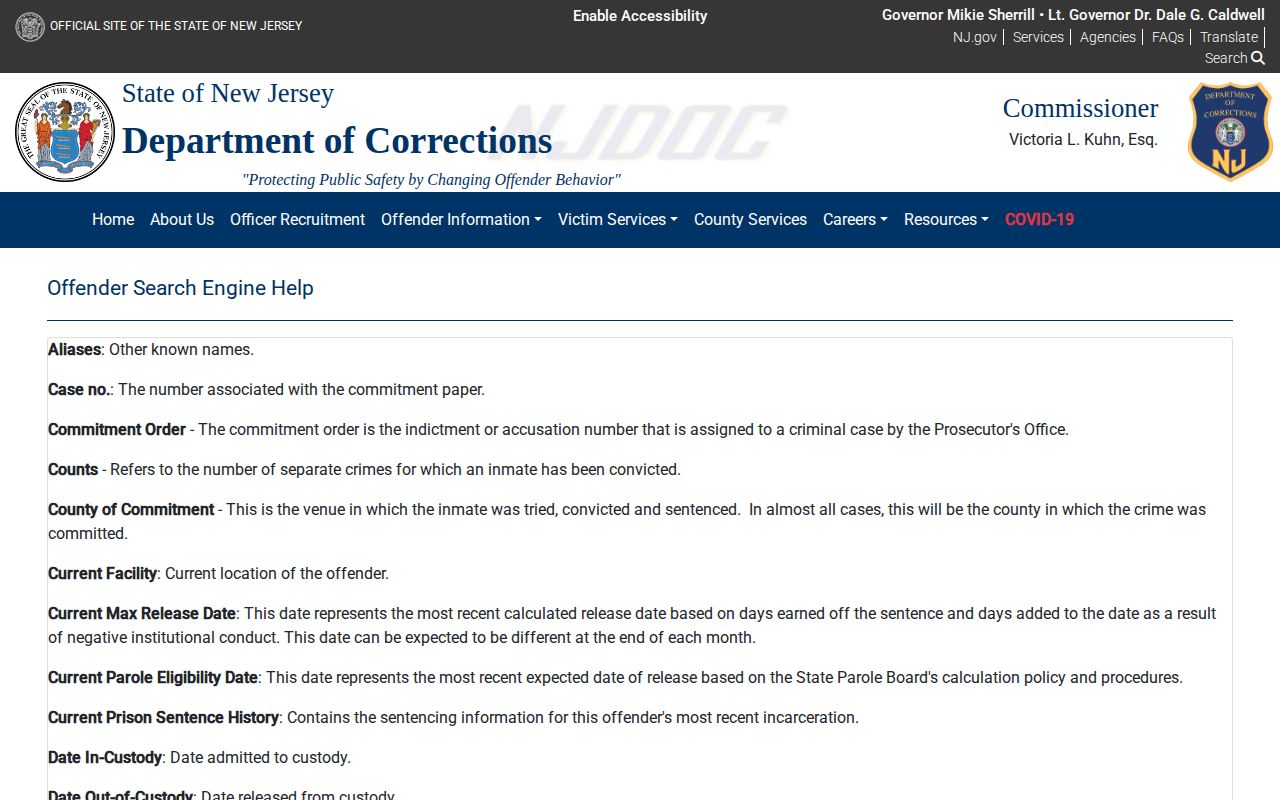
The image supports the meaning of the state fields. It does not display a county jail calculation or prove a named person's release.
Atlantic County Release Credit Rules
New Jersey sentence credits are not one simple percentage. R.S. 30:4-140 provides progressive commutation credits for continuous orderly conduct on covered state minimum-maximum sentences. Misconduct can cause forfeiture. The State Parole Board describes commutation credit as automatically applied rather than tied to a specific work assignment, although it can be lost.
R.S. 30:4-92 authorizes work and minimum-custody credits. The official parole glossary describes work credit as one day for each five days worked. It describes minimum-custody credit as three days per month during the first minimum-custody year and five days per month after that. Other lawful program or education credits may also apply. NJDOC and NJSPB perform the actual computation.
A mandatory minimum changes what credits can do. NJDOC's glossary says ordinary commutation and work credits do not cross a mandatory minimum, while court-awarded credits may apply as the law permits. N.J.S.A. 30:4-123.51 addresses general parole eligibility after a mandatory minimum, or after one-third of the sentence where none applies, less permitted credits. Eligibility remains distinct from release.
County sentences have a separate work-credit framework under N.J.S.A. 30:8-28.1 et seq. Atlantic County does not publish a public county projected-date field. Ask Gormley and the Judiciary for an existing calculation, judgment, and jail-credit record instead of applying the state formula by hand.
Atlantic County NERA Release Limits
The No Early Release Act, N.J.S.A. 2C:43-7.2, creates an 85 percent parole-ineligibility term for covered first- and second-degree violent crimes. It does not apply to every New Jersey prisoner. It also cannot shorten a longer mandatory minimum. The offense, degree, offense date, judgment, and statutory version all matter.
NERA is therefore not a universal release calculator. Even when it applies, the end of the ineligibility period is not the same as automatic release. Parole review, a later Board decision, an updated sentence calculation, and any other detainer still affect what happens next. Covered sentences can also include post-incarceration parole supervision, so leaving prison may begin a supervised period rather than end all state jurisdiction.
Use the judgment to see whether NERA or another mandatory term was imposed. Then use NJDOC and NJSPB records for the current calculation. Simple arithmetic from the sentence length can miss jail credit, concurrent or consecutive terms, amended orders, and later case activity.
Note: The 85 percent rule is offense-specific and should never be applied to an Atlantic County case without reading the controlling judgment.
Why Atlantic County Release Dates Change
A projected release date changes when the legal sentence or administrative calculation changes. Some factors move the date earlier. Others push it later or change release into transfer. The source of the change matters because no single portal shows every county, state, court, parole, and federal event at once.
| Factor | Possible effect | Record to check |
|---|---|---|
| Corrected jail credit | Changes the effective time remaining | Judgment, amended order, and NJDOC sentence history |
| Commutation, work, or minimum-custody credit | May reduce a calculated date within legal limits | NJDOC calculation and applicable statute |
| Institutional misconduct | May forfeit credits or add days to the calculation | NJDOC Current Max Release Date and institutional record |
| Added or consecutive case | Can extend the total custody term | Court judgments and sentence history |
| Parole denial or rescission | Can delay community release and set a Future Eligibility Term | NJSPB decision and NJDOC record |
| Detainer, warrant, or hold | May turn a release from one agency into transfer to another | Release destination, receiving agency, and court record |
A detainer is a request or legal hold from another authority. It can mean that the person leaves NJDOC or Gormley but does not enter the community. The recorded destination must be checked through the receiving county, NJDOC, BOP, ICE, or the relevant court. A facility's use of the word release may only mark the end of that facility's custody episode.
Atlantic County Community Release Status
Atlantic County's Home Electronic Detention and Day Reporting programs show why physical location is not the same as final discharge. Eligible participants may live at an approved home while remaining in a county community program. Home Electronic Detention uses electronic or alcohol monitoring and verification patrols. Day Reporting allows residence at home without electronic monitoring while requiring scheduled reports to the Main Jail Annex.
The official Community Release Programs page supplies the program details. A person outside the jail walls may therefore still have an active county status. Ask for the disposition and program status rather than recording the date they first returned home as a final release date.
This distinction also applies to parole. A person can be physically out of state prison and still remain under NJSPB jurisdiction. The VINELink check may provide a timely custody-event alert for a participating record, but the jail, NJDOC, court, or parole record provides durable confirmation.
Confirm Atlantic County Actual Release
For NJDOC custody, confirm Date Out-of-Custody and read it with status, sentence history, and parole information. For Gormley, request the existing release or discharge record sufficient to show the date and time custody ended, release authority, and disposition or destination. The county Jail Records number is 609-909-7551, though staff may limit what can be confirmed by telephone.
A court disposition explains the legal reason for release, such as dismissal, time served, probation, a county term, or state commitment. It is not the physical exit timestamp. Pair it with the custody record. When another agency follows, confirm that next custody episode too.
Pretrial cases need extra care. New Jersey uses a mainly risk-based pretrial system. A current order, detention decision, conditions, or bail where ordered controls release. Gormley's around-the-clock bail acceptance does not create a fixed release schedule and cannot override a judicial detention order.
Note: State calculations, court authority, and the final custody timestamp answer three different questions; preserve all three when timing matters.