
Atlantic County Parole Versus Probation
Parole and probation both allow a person to live in the community under rules, but they begin at different points. New Jersey parole follows release from a state prison and remains under the New Jersey State Parole Board. Probation is imposed by a judge and is supervised through the New Jersey Judiciary's Probation Division. A person can receive probation instead of a prison term, after time served in the county jail, or as part of a sentence set out in the judgment. Neither status is an Atlantic County jail release list.
The distinction decides where to verify the record. For parole, read the NJDOC sentence history and Date Out-of-Custody, then contact NJSPB about current supervision. For probation, start with the Superior Court judgment and Atlantic Vicinage. Pretrial monitoring is separate. It governs a pending case before judgment and must not be described as probation.
| Status | How it begins | Supervising authority | Best verification |
|---|---|---|---|
| Parole | Conditional release after state imprisonment | New Jersey State Parole Board | NJDOC Date Out-of-Custody, sentence history, and NJSPB confirmation |
| Probation | A sentence ordered by a court | New Jersey Judiciary Probation Division | Judgment, case disposition, and Atlantic Vicinage contact |
| Pretrial monitoring | Conditions in a case that has not reached final judgment | New Jersey Judiciary Pretrial Services | Current court order and Pretrial Services |
- Parole
- Conditional community release from a state prison sentence while NJSPB jurisdiction continues.
- Probation
- A court sentence served in the community under Judiciary supervision and stated conditions.
- Discharge
- The formal end of the supervising agency's authority, not merely release from a jail building.
- Absconder
- A supervised person whom the agency alleges has stopped reporting or cannot be located.
- Future Eligibility Term
- A period set after a parole denial or revocation before another parole review may occur.
Verify Atlantic County Post-Release Supervision
There is no public, name-searchable New Jersey parolee directory. Verification therefore uses a sequence of official records and a case-specific agency inquiry. Start with identity. A full name plus an SBI number, date of birth when lawfully known, or court case number helps prevent a false match. Then decide whether the last known custody was Gerard L. Gormley Justice Facility or an NJDOC institution.
- Search the NJDOC Incarcerated Person Search when a state prison sentence or transfer is possible. Compare the SBI number, aliases, County of Commitment, Current Facility, and sentence history.
- Read Date Out-of-Custody as the actual NJDOC release field. Treat Current Max Release Date and Current Parole Eligibility Date as calculated or prospective dates, not proof of release.
- For parole, contact the NJSPB Public Information Office with the person's name and SBI number. Ask for the precise supervision status rather than assuming any release remains active parole.
- For probation, find the Atlantic County judgment or disposition through New Jersey Courts, then use Atlantic Vicinage Criminal or Probation channels. The judgment shows whether probation was ordered.
- Confirm how supervision ended. A maximum-expiration discharge, parole discharge, court termination, revocation, or transfer represents a different event and can lead to a different record.
The broader search and county release-record path is available on the Atlantic County released inmates home page. It is the better starting point when the last custodian or type of release is not known.
Note: A person may be out of physical custody yet remain under parole, probation, mandatory supervision, or another court-ordered community status.
Atlantic County Parole Office Details
District Parole Office 8 is the local NJSPB office serving Atlantic County, Cape May County, and southern Ocean County. Its service area makes it a useful contact for routing a supervision question. It does not prove that every person convicted in Atlantic County reports there. Residence, assigned district, supervision type, and later transfers can change the proper office.
New Jersey State Parole Board, District Office 8
700 Black Horse Pike, Suite E-1
Pleasantville, NJ 08232
609-415-6630
NJSPB Public Information Office
609-292-4257
SPB-Public-Info-Office@spb.nj.gov
The Public Information Office accepts questions about a person eligible for or under parole supervision. Give enough detail to identify the record, but do not send more personal data than the agency asks for. For a release calculation or state custody history, NJDOC remains the record source. District Office 8 handles supervision rather than rewriting the prison record.
Atlantic County Probation Record Path
Atlantic County probation starts with the criminal judgment. The New Jersey Courts criminal system can show the case, disposition, and sentence for an indictable Superior Court matter. A judgment may state probation, a county jail term, time served, or a state prison commitment. That legal outcome helps explain why the Gormley custody episode ended, though it does not supply the exact jail-door timestamp.
The Atlantic Vicinage Criminal Division main line is 609-402-0100, extension 47310. Criminal Records uses extension 47320. Pretrial Services uses extension 47280. Those separate contacts matter because a pretrial condition is not a probation sentence. Court records are governed by Judiciary rules, and sealed or expunged matters may not appear in public tools.
Ask for the existing judgment, order, or case status. Do not ask staff to infer a supervision status from a missing jail name. When exact county release time is also needed, compare the judgment with the Division of Adult Detention release record. The court explains the authority; the detention record closes the custody episode.
Note: Probation can continue after a short county stay, but the sentence and court office, not a jail roster, establish that supervision.
Atlantic County Parole Hearing Status
A parole hearing, a grant, and actual release are separate facts. NJSPB begins with an initial hearing or review and may proceed to a two-member panel. A grant sets a future scheduled parole-release date and conditions. A denial sets a Future Eligibility Term. New information can lead to rescission before release. The official NJSPB hearing process explains these stages.
The captured hearing page below shows the state source used to interpret parole outcomes. It should be read with NJDOC Date Out-of-Custody when the question is whether release actually happened.
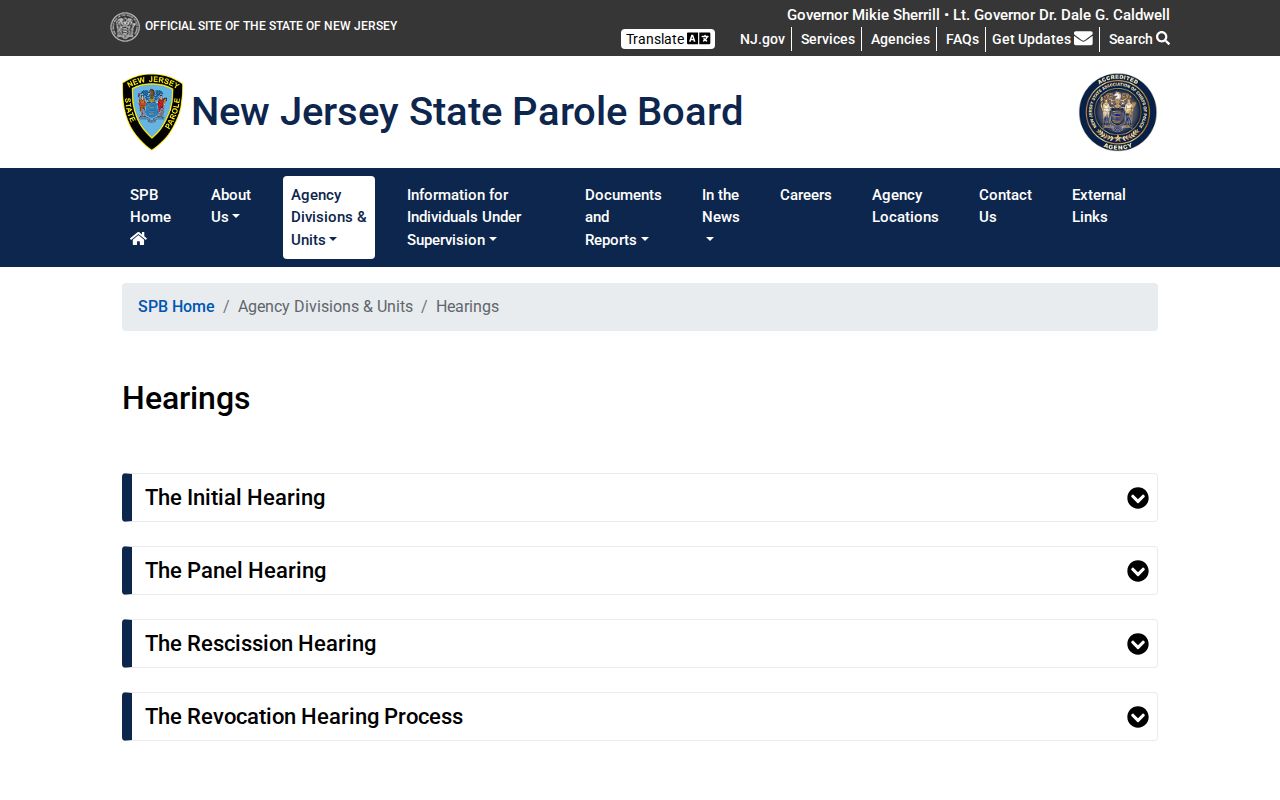
A hearing outcome can shape a projected date, but only the later custody record confirms that the person left NJDOC.
No public person-by-person hearing calendar or searchable decisions database was found. The rolling Parole Eligibility Notice is the nearest public schedule layer. It lists prospective candidates by county group. It is not a release list and does not show that parole was granted.
The NJSPB fiscal 2024 report gives statewide workload totals rather than named results. It reports 621 panel hearings scheduled, 495 decided, 232 denied, 263 granted, and 126 not feasible. Those figures describe the Board's work. They cannot verify the outcome or current supervision status of one Atlantic County person.
The eligibility-notice page shown here illustrates that distinction. A listed Atlantic County candidate may be considered, while the actual result still requires Board and NJDOC confirmation.
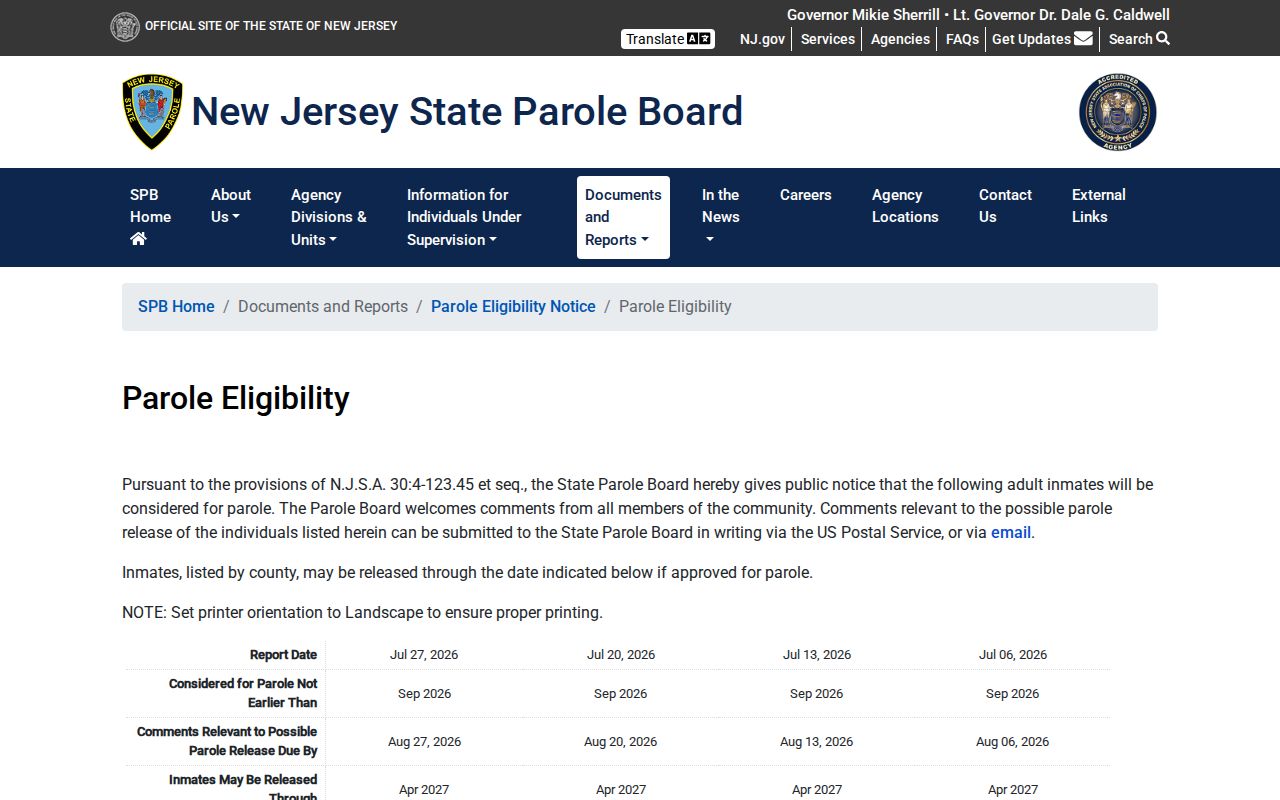
The notice is useful for timing a follow-up inquiry. It cannot replace an individual decision or release record.
Atlantic County Parole Violations
NJSPB field officers monitor conditions and community adjustment. The Board also supervises statuses such as Mandatory Supervision, Community Supervision for Life, and Parole Supervision for Life. Conditions vary by case. A claimed violation can lead to review or revocation proceedings, but it is not a new conviction by itself.
If parole is revoked, the Board may set a Future Eligibility Term. It may also continue parole, sometimes with added conditions. An alleged absconder status is similarly specific. NJSPB accepts anonymous tips at SPB-Fugitive-Tip-Submit@spb.nj.gov, but that address is a tip channel, not a name-search tool. No official searchable New Jersey absconder or parole-warrant list was found.
For a genuine status question, use NJSPB case-specific contact. For immediate danger, contact emergency services rather than attempting to locate or approach the person. VINE can notify on a participating custody event, but it does not serve as a parolee directory and cannot establish a current warrant.
Atlantic County Release Planning
Atlantic County has a local discharge process for scheduled county-sentence releases. The county's Inmate Services program says formal discharge planning began on February 22, 2005. A clinician assesses county-sentenced people who are due for release. Outside nonprofit representatives may meet with them about ten days before discharge to begin applications and arrange community appointments.
This program is not parole verification. It also does not cover every sudden bond or court-ordered release in the same way. Its value is more practical: a planned transition can begin before the Gormley sentence ends, while any later probation or parole status still comes from the court or NJSPB. Ask each agency about the record it controls.
Supervision ends only through the responsible authority's formal action. NJSPB may discharge parole at maximum expiration or another authorized point. A court controls probation termination. A missing name, finished program appointment, or old eligibility notice does not establish that final discharge.
Note: Confirm the last step with the responsible agency because physical release, supervised release, and complete discharge are different Atlantic County record events.